


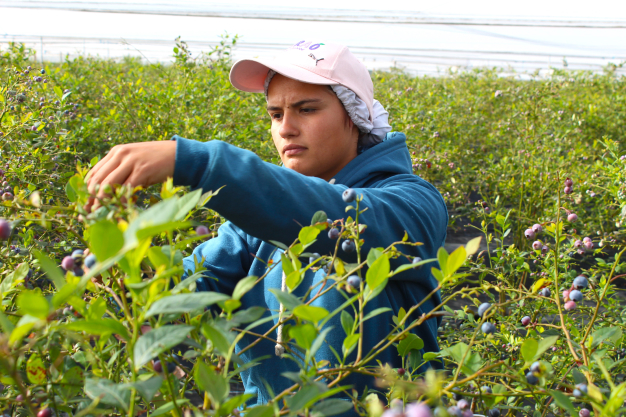
Blueberry cultivation is a process that requires patience, technique, and close attention at every stage. However, there is one moment in particular where all the effort is truly put to the test: the harvest.
This is when it is determined whether the fruit meets quality standards, whether it can compete in demanding markets, and ultimately whether the crop will be truly profitable.
Many producers who start on this path tend to focus on planting, irrigation, or fertilization, but over time they discover that a harvest can affect even the best crops.
It is not enough to produce blueberries https://morao.org/la-floracion-de-los-arandanos-un-proceso-delicado-para-una-cosecha-perfecta/, it is necessary to know when, how, and under what conditions to harvest them.
In Colombia, where this crop has been growing rapidly, there is increasing interest in professionalizing processes. This involves not only growing but doing so well at every stage. In this learning process, access to clear and practical information has been key.
For example, spaces like Morao have allowed many producers to access more practical content, where complex processes are explained in a simple way, making decision-making in the field easier.
Blueberry harvesting does not happen at a single moment nor does it follow a single formula. It depends on factors such as climate, variety, crop management, and market conditions.
That is why understanding the complete process—from flowering to packaging—allows producers to anticipate problems and make better use of every opportunity.
This article is designed as a comprehensive guide, both for those who are just starting out and for those who want to optimize their results. Here you will find both the step-by-step process and practical recommendations that can make a real difference in the quality of your production.
Flowering: the beginning of a good harvest
Importance of this stage
Everything begins long before the fruits appear. Flowering is the stage where much of the crop’s productive potential is defined. A plant that flowers uniformly will have a more organized harvest, which facilitates picking and improves fruit quality.
In addition, good flowering allows for better harvest logistics planning, which is key when aiming for efficiency.
Factors that influence flowering
- Stable climatic conditions
• Balanced nutrition
• Proper irrigation management
• Timely pruning
Many farmers have improved this stage by accessing reliable technical information. In fact, it is now common to see producers complementing their field experience with specialized content, such as that found on platforms like Morao, where these processes are explained clearly and practically.
Fruit development: keys to obtaining quality blueberries
Formation and growth of blueberries
After flowering, a critical stage begins: fruit development. This is where final quality is built. Proper management at this stage directly influences the size, flavor, and firmness of the blueberry.
Key aspects:
- Consistent but controlled irrigation
• Stage-specific nutrition
• Constant pest monitoring
Visible changes in the fruit
The ripening process can be easily identified:
- Green: unripe fruit
• Pink: transition stage
• Deep blue: optimal point
Understanding these changes is essential. Many harvesting mistakes come from not recognizing these stages.
When to harvest blueberries?
The exact point of ripeness
A blueberry ready for harvest must meet several characteristics:
- Uniform color across the entire surface
• Easy detachment
• Firm but not hard texture
Harvesting at the right time improves quality and also increases shelf life.
The importance of timing in demanding markets
In export markets, a few days can make a difference. Fruit harvested too early may lack flavor, while overripe fruit can deteriorate quickly.
For this reason, more and more producers are refining their processes based on updated technical knowledge, relying on accessible educational resources.
Blueberry harvesting techniques
Manual harvesting: precision and care
Most blueberries https://morao.org/como-la-revolucion-del-arandano-esta-cambiando-el-panorama-agricola-en-colombia/ destined for premium markets are harvested manually. This allows for careful fruit selection.
Advantages:
- Less damage
• Better presentation
• Greater quality control
Good practices during harvesting
- Do not squeeze the fruit
• Avoid harvesting under excessive moisture
• Use clean and appropriate containers
• Reduce the time between harvesting and cooling
These practices, although simple, make a huge difference. Likewise, many producers agree that learning these details—through experience or specialized content like Morao—has been key to improving their results.
Post-harvest handling: where final quality is defined
Fruit classification
Once harvested, blueberries https://morao.org/como-cultivar-arandanos-en-colombia-clima-suelo-y-cuidados-para-una-produccion-exitosa/ are classified according to:
- Size
• Color
• Physical condition
This allows separation between export-quality fruit and fruit destined for local consumption.
Cold chain: a critical factor
Blueberries are highly perishable. If they are not cooled quickly, they lose quality within hours.
Therefore, maintaining the cold chain is not optional—it is essential.
Proper packaging
Packaging must ensure:
- Fruit protection
• Ventilation
• Preservation
Common mistakes in blueberry harvesting
Early or late harvesting
One of the most frequent mistakes. It directly affects flavor and quality.
Improper fruit handling
Impacts, pressure, or poor handling reduce commercial value.
Lack of planning
Failure to organize the process can lead to unnecessary losses.
Most of these mistakes can be avoided with training and access to clear information, which is now much more accessible thanks to specialized platforms.
How to improve harvesting efficiency?
Continuous team training
A well-trained team:
- Reduces errors
• Improves timing
• Increases quality
Process organization
Planning harvesting routes, timing, and logistics optimizes resources.
Technological support
Sensors, records, and monitoring help make more precise decisions.
The role of knowledge in modern agriculture
Today, knowledge is as important as land or water. Producers who invest in learning achieve better results and adapt more quickly to market changes.
In this context, access to practical and well-explained information becomes essential. Morao has emerged precisely to bridge that gap, bringing useful content that helps understand processes like harvesting from a clearer and more strategic perspective.
It is not enough to know what to do; it is essential to understand why to do it and when.
The future of blueberry harvesting in Colombia
Greater technification
Technology will continue improving harvesting precision.
Higher quality demands
Markets will demand increasingly uniform products.
Better-prepared producers
Access to information will continue raising the level of the sector.
In addition, the strengthening of informed agricultural communities will allow more producers to share experiences, learn together, and raise production standards in the country.
Every decision in harvesting builds the final result
Harvesting is not just another step in cultivation—it is the moment when everything comes together. Each fruit collected reflects the care, technique, and decisions made throughout the entire process.
If you are growing blueberries or want to start, taking the time to understand how to harvest properly can make a huge difference in your results. Today, you have the advantage of access to more information, tools, and learning spaces than ever before.
Making use of that knowledge, applying it in the field, and continuously improving is what truly separates an average crop from a successful one.
If you want to learn more about how Morao is connecting the field with people and promoting more conscious food consumption, we invite you to explore their project here: https://morao.org/sobre-morao/